
Why More Payment Options Can Actually Hurt eCommerce Conversions in 2025
By Shivam Sati · Published on December 29, 2025
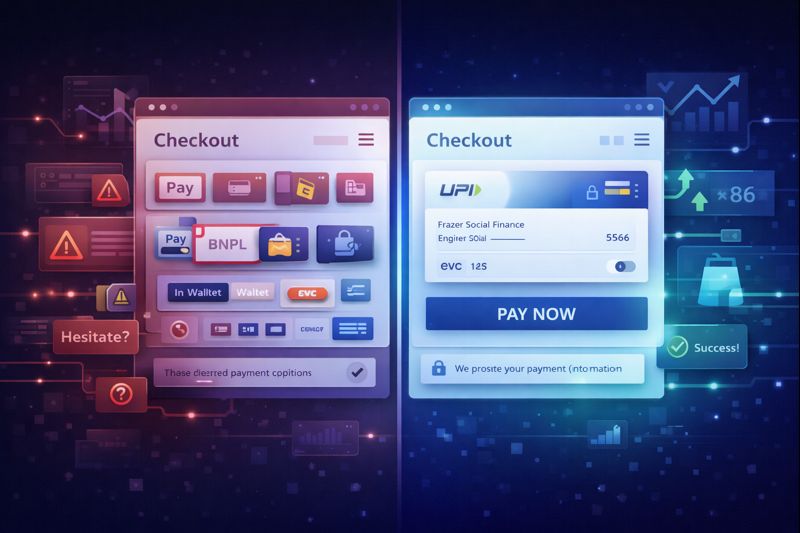
At first glance, offering more payment methods sounds like a smart strategy. Cards, UPI, wallets, BNPL, EMI, net banking — the logic seems simple: give users more choice and conversions will increase.
But in 2025, many businesses are discovering the opposite.
Too many eCommerce payment options can actually confuse users, slow down checkout, reduce trust, and ultimately hurt conversion rates. Instead of making the buying decision easier, excessive choices often create hesitation at the most critical moment.
Let’s explore why more payment options don’t always mean more sales — and what actually works better.
📑 Table of Contents
- The Psychology of Choice Overload
- How Too Many Payment Options Affect Checkout UX
- Trust Issues Caused by Excessive Payment Methods
- Performance and Failure Risks at Checkout
- What Smart eCommerce Stores Do Instead
- Finding the Right Balance for Payment Options
1. The Psychology of Choice Overload
Humans like choice — but only up to a point.
When users reach checkout, they are already mentally committed to buying. Presenting too many eCommerce payment options at this stage forces them to think again, compare, and hesitate.
This phenomenon is known as choice overload.
Instead of:
“Let me pay quickly and finish”
Users start thinking:
“Which option is best?”
“Which one is safest?”
“What if this fails?”
That pause is dangerous. Every extra second increases drop-off risk.
In eCommerce, speed and clarity convert better than abundance.
2. How Too Many eCommerce Payment Options Affect Checkout UX
Checkout UX is about reducing friction, not adding features.
When too many payment options are displayed:
- The checkout page becomes cluttered
- Users need to scroll or expand sections
- Important buttons become less visible
- Mobile experience suffers badly
On smaller screens, excessive payment choices overwhelm users even faster.
Instead of feeling flexible, the website feels complex and unreliable.
A clean checkout with focused eCommerce payment options performs better than a crowded one with everything enabled.
3. Trust Issues Caused by Excessive Payment Methods
Trust is fragile at checkout.
Users trust:
- Familiar payment methods
- Recognizable gateways
- Options they have used before
When a checkout shows too many unknown wallets or rarely used methods, it raises questions:
- “Why are there so many?”
- “Is this site secure?”
- “Which one should I trust?”
Ironically, adding more payment options can reduce trust instead of increasing it.
In 2025, users prefer fewer but well-known eCommerce payment options over dozens of unfamiliar ones.
4. Performance and Failure Risks at Checkout
Each payment method adds technical complexity.
More payment options mean:
- More API calls
- More third-party dependencies
- Higher chance of failures
- Slower checkout loading
If even one payment option fails or hangs, users often assume the entire website is broken.
Payment failures are one of the fastest ways to permanently lose customers. Many users don’t retry. They leave and never return.
Simplifying eCommerce payment options reduces failure points and improves reliability.
5. What Smart eCommerce Stores Do Instead
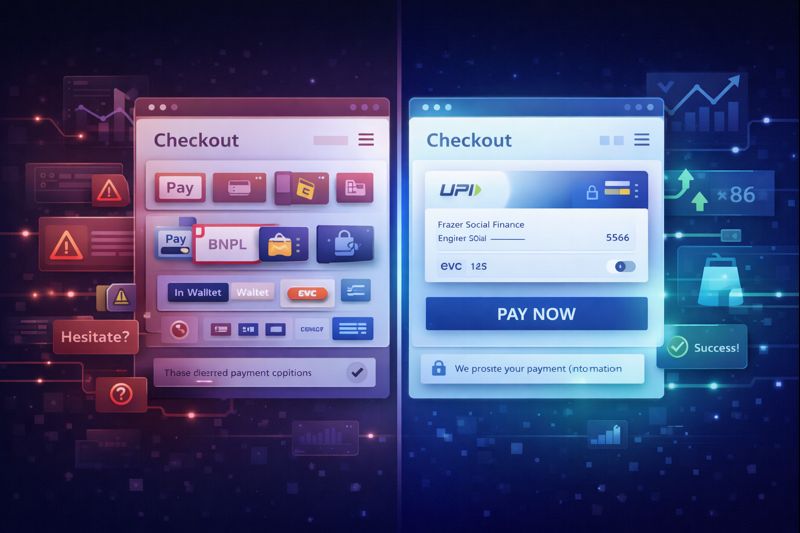
High-converting eCommerce stores don’t add everything. They curate.
Smart strategies include:
- Showing only the top 2–3 payment methods by default
- Prioritizing region-specific trusted options (like UPI in India)
- Hiding secondary methods behind expandable sections
- Optimizing payment order based on usage data
Instead of asking users to choose, these stores guide them toward the fastest and most trusted option.
The goal is not choice — it’s confidence.
6. Finding the Right Balance for eCommerce Payment Options
The right number of eCommerce payment options depends on:
- Target audience
- Geography
- Device usage
- Product price range
For most stores in 2025:
- 2–4 primary payment options are ideal
- Mobile-first methods should be prioritized
- Rarely used methods should be removed or hidden
Regularly reviewing payment analytics helps identify which options actually convert and which ones only add noise.
Why Fewer Payment Options Often Convert Better
When checkout is simple:
- Users feel confident
- Payments complete faster
- Errors reduce
- Trust increases
Fewer payment options don’t limit users — they guide them.
In eCommerce, clarity beats flexibility at the final step.
❓ Frequently Asked Questions
Do more payment options increase eCommerce conversions?
Not always. Too many payment options can overwhelm users, reduce trust, and increase checkout abandonment.
How many eCommerce payment options are ideal in 2025?
Most stores perform best with 2–4 well-known and trusted payment options, optimized for mobile users.
Should all payment methods be removed?
No. Secondary payment methods can be hidden behind expandable sections instead of being removed completely.
📩 Need Help Optimizing Your Checkout?
If your eCommerce website has high cart abandonment or payment failures, we can help. We design conversion-focused eCommerce websites with optimized checkout flows and carefully selected payment integrations that improve trust and performance.
📧 [email protected]
📞 +91 9306526234
🧾 Final Thoughts
In 2025, adding more features does not automatically improve conversions. This is especially true for eCommerce payment options.
The best-performing online stores focus on simplicity, trust, and speed. By reducing friction at checkout and guiding users toward familiar payment methods, businesses can significantly improve conversion rates.
Sometimes, less really does convert more.
Previous Post
What Makes an ecommerce website trustworthy in 2025?
Next Post
Why Most Businesses Outgrow Their Website Faster Than They Expect
Comments (0)
No comments yet. Be the first to share your thoughts.
Related Posts
Why One-Click Checkout Is Becoming Essential for eCommerce in 2026
In eCommerce, every extra step between adding a product to the cart and completing a purchase increases the…
7 UX Mistakes That Are Killing eCommerce Sales in 2026
Introduction A great product and strong marketing can bring visitors to an online store, but poor user experience…

How AI Shopping Assistants Are Changing eCommerce in 2026
Introduction Online shopping has evolved rapidly over the past decade, but the biggest transformation is happening right now.…